AIO / GEO optimisation
 Matthew BoyleLast updated: 20 October 2026
Whilst a lot of the principles that exist in SEO can be applied to AIO, these are techniques I have found to have helped move the needle in terms of optimising for AI chatbots.
Who we are

Matthew Boyle
Matthew Boyle is a seasoned professional having helped businesses get cited in AI answers from ChatGPT, Gemini and Google AI Overviews. He has deep AIO and GEO optimisation experience.
View Matthew Boyle's LinkedIn profileWhat AIO optimisation costs with an expert agency
The cost of an AIO optimisation expert who provides consultancy and agency services can depend on the scope of the project and what exactly is needed. Below we have listed the prices we charge for the service. If you wish to have more information then contact us.
| What's included | One-off audit£500 | Monthly service£1,500per month |
|---|---|---|
| AI search visibility check (ChatGPT, Gemini, Perplexity) | ✓ Included | ✓ Included |
| Google AI Overviews presence review | ✓ Included | ✓ Included |
| Brand mention and citation analysis | ✓ Included | ✓ Included |
| Content structure recommendations | ✓ Included | ✓ Included |
| Content rewritten for AI answers | ✗ Not included | ✓ Included |
| Entity and schema optimisation | ✗ Not included | ✓ Included |
| Third-party citation building | ✗ Not included | ✓ Included |
| Monthly AI visibility tracking report | ✗ Not included | ✓ Included |
A guide to AIO and GEO optimisation for AI search
Stay plugged into the AI search community
AI search is the fastest-moving area in marketing right now. How ChatGPT, Google's AI Overviews and Perplexity choose their sources can shift month to month.
For the foundations, read the original research paper on generative engine optimisation by researchers from Princeton and others. It's free on arXiv. Google's Search Off the Record podcast has covered how AI is changing Search, straight from the people who build it. On Reddit, r/SEO increasingly covers AI search and GEO alongside traditional SEO.
This field is changing weekly. Stay switched on or risk optimising for how AI search worked a year ago.
Consider hiring an AI search optimisation expert
More people now ask ChatGPT, Gemini and other AI tools for recommendations instead of searching Google. If you want your business to show up in those answers, an AI search optimisation (AIO) expert can help. You could hire a freelance consultant, a specialist agency, or pay for one-off services like an audit.
A good expert will check what AI tools currently say about your business, then improve your website content so it’s easier for AI to understand and quote. They’ll also help get your brand mentioned on trusted sites, review platforms and communities like Reddit.
Be careful when hiring. This is a new field, so be wary of anyone claiming years of AIO experience or guaranteeing you’ll appear in ChatGPT. Look for solid SEO experience, real client results and someone who explains things in plain English.
Be patient: Rarely does success happen overnight
Getting your business mentioned in AI answers, from Google’s AI Overviews to ChatGPT, isn’t an easy game to win. For most businesses it takes months, not days.
Don’t give up if AI tools don’t mention you straight away. Stick to the strategies in this guide: answer real customer questions clearly, keep your information accurate and consistent everywhere, and get mentioned on trusted sites. Each mention helps AI tools learn a little more about who you are.
Keep checking your results and keep adjusting. The businesses that show up in AI answers are usually the ones that keep going.
Build your brand, not just your website
A study of 250 retailers found that the strongest predictor of being mentioned by AI tools wasn't technical website work. It was how well known the brand already was. Big, famous brands get named regardless, while well-built websites from lesser-known brands often go unmentioned. For a small business, that means AI visibility comes from getting your name out there: press coverage, reviews, social media, local partnerships and word of mouth. The more people search for and talk about your brand, the more AI tools will mention it.
Get on the pages AI keeps quoting
AI answers lean heavily on a small number of websites. Ask ChatGPT or Google's AI Mode the questions your customers ask, then look at which websites it cites as sources. You'll often see the same review sites, comparison sites, blogs and news articles coming up again and again. Those are the pages that shape the answer. Work out how to get your business mentioned on them, whether through a review, a feature, a guest article or a press story. Getting onto a few of them can beat creating lots of new content.
Being mentioned isn't being recommended
Showing up in an AI answer and being recommended in it are two different things. ChatGPT might list five businesses but only recommend one or two. When you test your customers' questions, note whether you're simply mentioned or actually recommended as the best choice. If you're mentioned but rarely recommended, the problem is usually how people feel about you, so work on your reviews and reputation. If you're recommended when you appear but rarely appear, you need to get mentioned in more places.
Check the same questions every month
Write a list of ten questions your customers might ask an AI tool, such as "who's the best wedding photographer in Brighton?". Every month, ask each one in ChatGPT and Google's AI Mode and note whether your business appears. A one-off check tells you little, because AI answers change. Tracking the same questions over time shows you which ones you reliably win, which ones you've lost and which ones you've never appeared in. That tells you exactly where to focus your effort next.
If you have the budget and can afford it, then invest in prompt tracking software.
Don't judge AI by clicks alone
Many people read an AI answer and never click a link. Instead, they search for your business name later, type your web address straight in, or come back another day. So your website analytics will only show a small slice of what AI is doing for you. Watch for rises in people searching your brand name in Google Search Console, and in direct visits to your website. Better still, ask every new customer "how did you hear about us?". You might find AI is sending you more business than you thought.
Using Youtube
Tips for optimising AI through leveraging YouYube
Start a YouTube channel for your brand or leverage your existing one
YouTube is not just a social media platform — it is the second largest search engine in the world. People search for answers, tutorials, and recommendations on YouTube the same way they do on Google, and it surfaces in traditional search results too.
Google AI pulls more from YouTube than text-based blogs for tutorials, and brands with educational video libraries benefit most. Text-based blog posts are losing ground to structured, visual formats in AI search visibility.
YouTube citations in Google's AI Overviews increased by 414% overall. How-to videos jumped by 651% and visual demo-style videos by 592% — both leading all content types. YouTube is now the most-cited video source in AI Overviews, with instructional and step-by-step content favoured over opinion pieces.
From an AI optimisation standpoint, Google's own AI tools have unrestricted access to YouTube content in a way that other AI systems do not. That gives you a presence on a platform that competitors relying purely on web content may struggle to match.
YouTube also has its own authority signals, similar in principle to how Google uses PageRank to separate legitimate sites from low-quality ones. An established, active channel with genuine engagement carries weight. It is another trust signal for your brand, and one that feeds back into your broader online reputation.
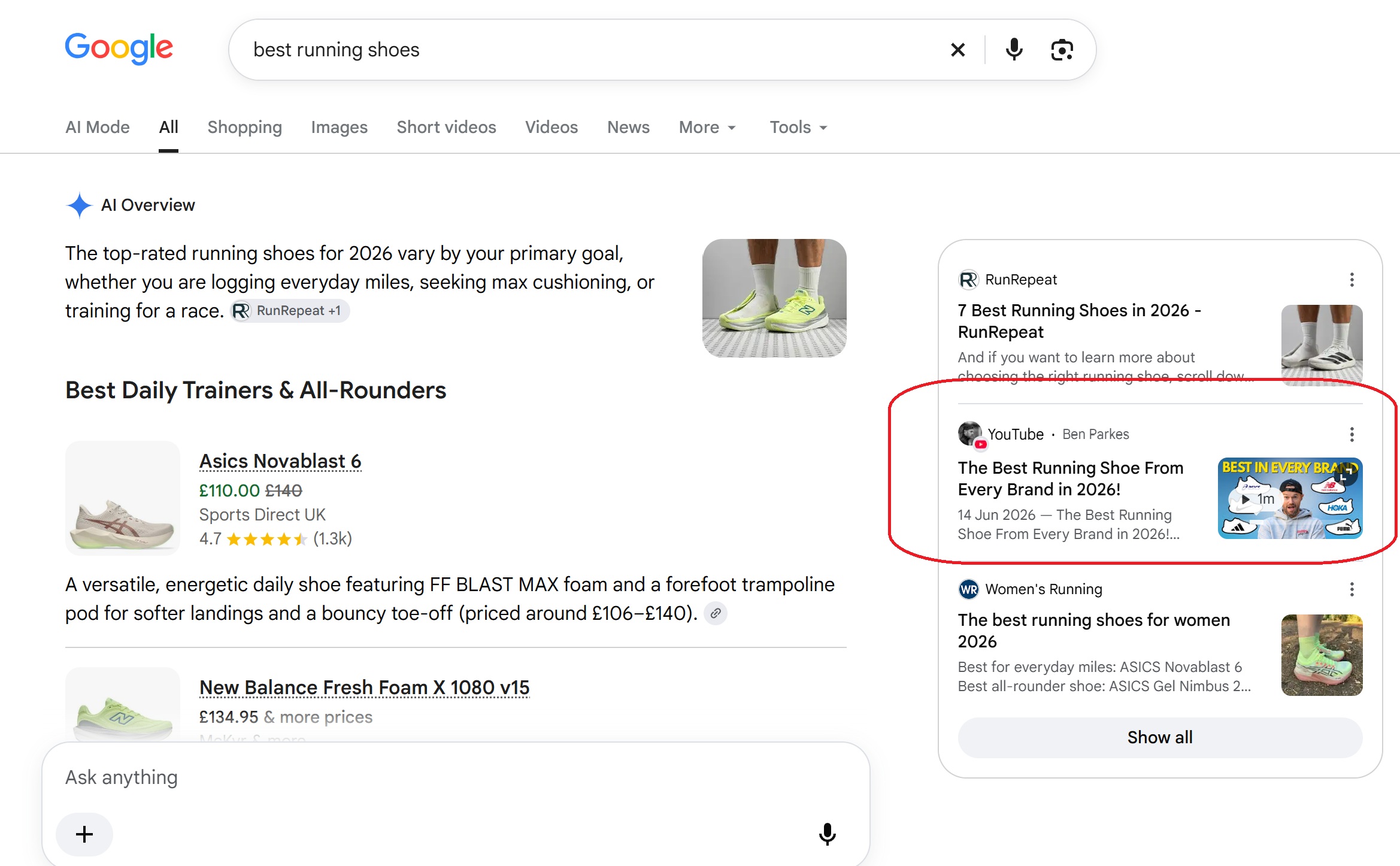
Google has full access to YouTube and can understand the content that is published there by analysising the video's content and also providing automatic transcriptions and translations.
Structure and add context to your videos
A video that is just a recording with no supporting information is a missed opportunity. Add transcripts — AI systems consume a significant amount of processing to analyse raw video, so a transcript makes your content far more accessible and more likely to be used as a source. Use chapters to break the video into labelled sections. Write a proper description that explains what the video covers. Use your title accurately and specifically.
Think of it the same way you would a well-structured web page. The more context you give the platform and the algorithms around the video itself, the more likely it performs it performs.
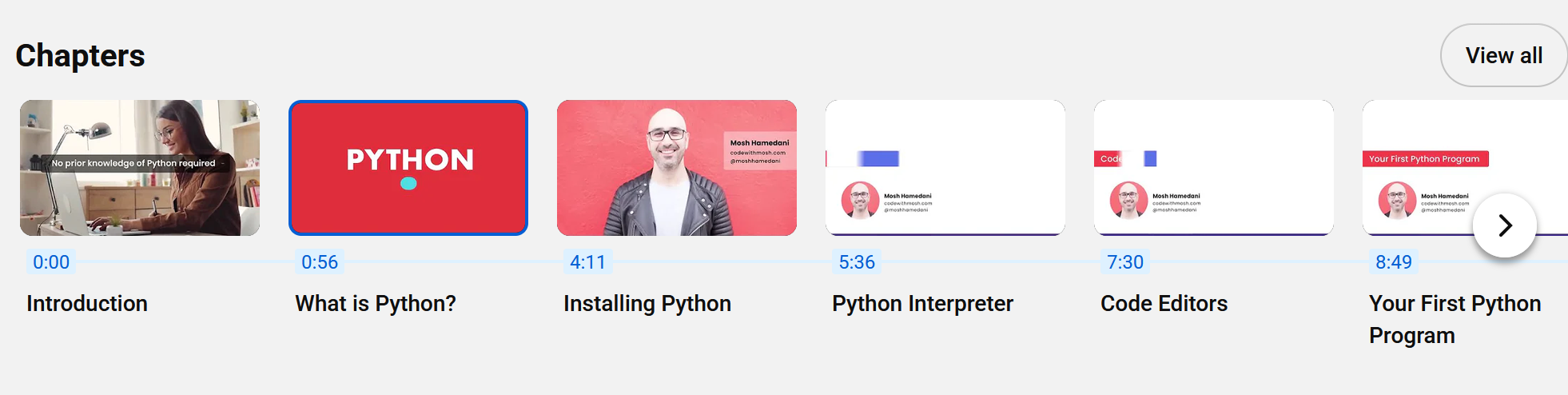
Chapters not only help your users navigate to the correct location but also help AI tools understand the content better. As of writing, the token-cost of crawling an entire video is too expensive to do at scale so AI tools will make use of any extra context given.
Using Reddit
These tips won't be for everyone but if you can make use of Reddit, you are on to a good start.
Create a subreddit for your brand
This tip won’t suit every business, but if you have loyal customers or plenty to talk about, it’s worth considering.
Reddit has a big influence on AI search. Many AI tools rely heavily on it when they put answers together and choose what to cite.
So what people say about you on Reddit can shape what AI says about you. With your own subreddit, you steer the conversation yourself instead of leaving it to strangers who might get the facts wrong.
Take control of your story before someone else does.
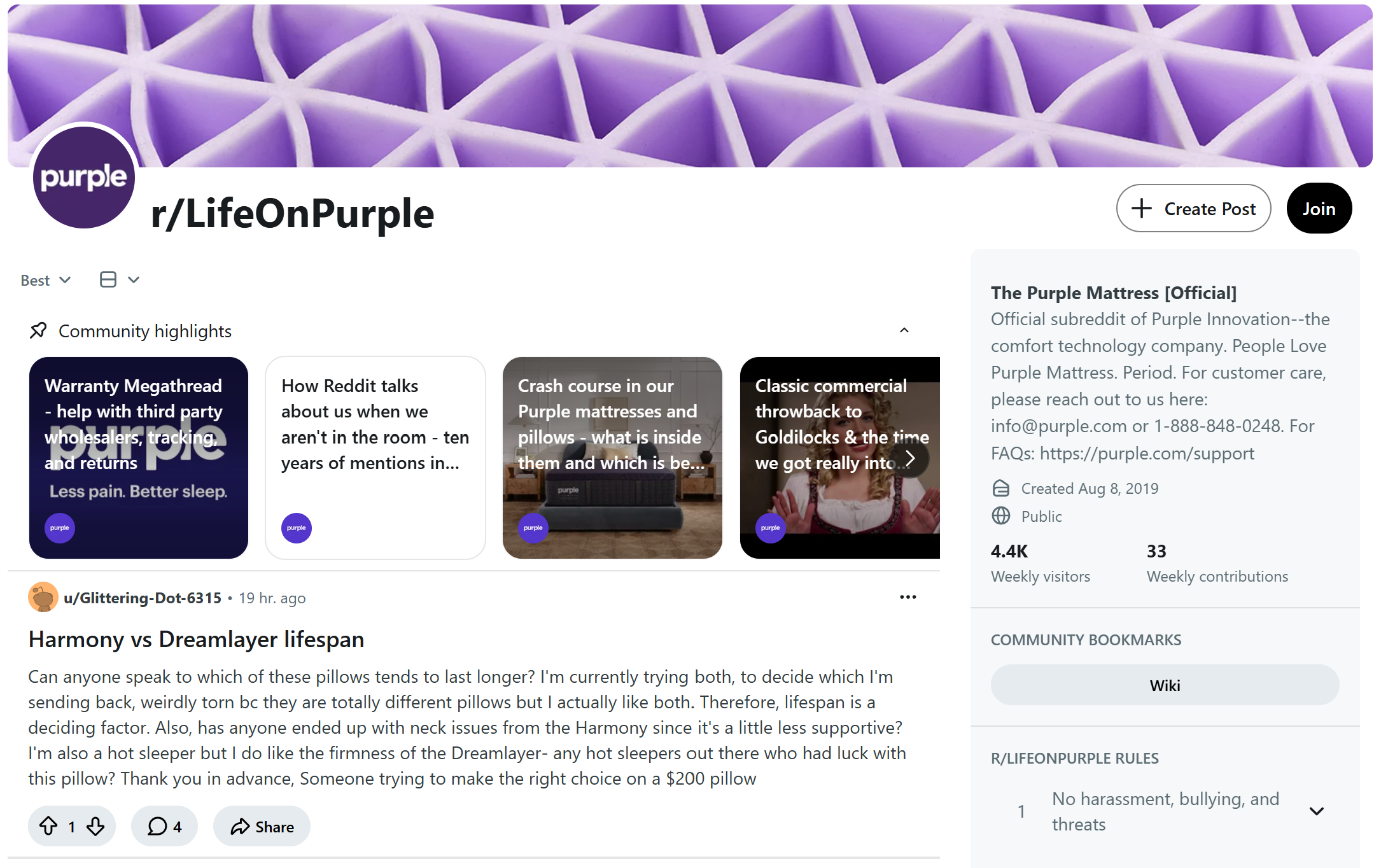
Purple Innnovation, a matress company host their own subreddit. By doing this, it allows they to own their space on Reddit, correct non factual information that gets posted about their brand and help answer questions or quieries. Perfect for the AIs to swoop in and use the data.
Track Reddit for mentions of your brand
Reddit is full of local communities where people talk about what’s happening in their town or city, so your business is likely to come up at some point.
Set up a Reddit monitoring tool that alerts you whenever someone mentions your brand. Then you can log in and reply, whether it’s a complaint or a compliment.
This matters more than ever. If someone posts something untrue about your business and nobody corrects it, AI tools may pick it up and repeat it as fact.
Spot it early, correct it quickly and protect your reputation.
Crawlability
Tips to help make sure your site is crawlable for the crawlers and agents.
Check that your FAQ sections that are hidden in accordions on your website aren't invisible to search and AI crawlers
What It Is FAQ accordions are interactive web elements that expand to reveal answers when a user clicks on a question. They allow pages to store a dense amount of structured information in a clean, compact layout.
However, many websites build these accordions using dynamic JavaScript that loads the text into the Document Object Model (DOM) only after an interactive click event occurs. Without that user interaction, the text does not exist in the rendered page code.
Why It Matters Search engine crawlers and LLM scrapers generally browse pages in a static state—they do not trigger click events or interact with collapsed elements as a human user would.
If your FAQ content requires a click to physically load into the code, search engines and AI models will treat that content as invisible. This means valuable long-tail keywords, direct answer targets, and rich context won't be indexed or used to train AI models on your brand.
And a really key important part, the type of quesiton you include in your FAQs are by definition freuqntly asked questions and are going to be the EXACT same type when prompted by the user in their LLM tool. It can be some of your most important helpful content and its hidden.
How to Check and Fix You can audit your website's FAQ components in under a minute using Chrome DevTools:
Open a page on your site with collapsed FAQs using Google Chrome.
Click to open one of the questions and copy a unique phrase from inside the answer.
Right-click anywhere on the page and select Inspect to open DevTools.
Select the Elements tab, press Ctrl + F (or Cmd + F on Mac), paste the text, and press Enter to confirm the text string appears in the source code.
Reload the page while keeping DevTools open, without clicking or interacting with the page.
Search for the exact same text string in the Elements tab again.
If the text string is missing on your second search, the component is only injecting text on a click event. To correct this, the hidden content should be rendered directly into the HTML upon initial page load, using standard CSS properties (like display: none or visibility: hidden) to handle the visual expand/collapse behavior.
Frequently asked questions about AIO and GEO optimisation
Do you charge for AIO and GEO optimisation on a fixed-project, hourly or monthly retainer basis?
I don't charge by the hour. My AIO and GEO optimisation services come in two fixed-price options: a one-off audit for £500, or a monthly retainer at £1,500 per month.
The audit is a fixed project with a clear end result, so you know the full cost up front. The retainer is a monthly fee for ongoing, hands-on work. If you're not sure which suits you, get in touch and I'll recommend one.
How much time and resources will you need from our team during the research phase?
Very little. Before I start, I'll send you a briefing form with questions about your business, the questions your customers ask, your key content and where your brand is already mentioned online. Once you've filled that in, I'll take care of the research and only come back to you if I need access to something or have a question.
How long will it take to see results from AIO and GEO optimisation?
How long is a piece of string? It depends on the campaign, and it can take anywhere from a few days to several months. Some changes, such as restructuring key pages so AI tools can pick out clear answers, can make a difference within days. Others, such as earning citations on the sites AI tools trust and becoming the brand they recommend, take months.
Once I've reviewed your current visibility in AI answers, I'll give you a realistic timeline for your situation.
What's the difference between the AIO and GEO optimisation audit and the monthly retainer?
With the audit, I'll present you with an audit document full of recommendations, which you or your team can then put into action.
The audit covers:
- AI search visibility check (ChatGPT, Gemini, Perplexity)
- Google AI Overviews presence review
- Brand mention and citation analysis
- Content structure recommendations
With the retainer, I'm hands-on. I'll help with the day-to-day management of your AIO and GEO optimisation and we'll have regular check-ins to review progress.
On top of everything in the audit, the retainer includes:
- Content rewritten for AI answers
- Entity and schema optimisation
- Third-party citation building
- Monthly AI visibility tracking report
Matthew Boyle
Digital Marketing Consultant · ~20 years experience
Matthew Boyle has over 20 years experience in digital marketing covering a wide range of topic areas. He is available for a one-off consultation or ongoing support.
View my LinkedIn profile